CIFF 2010: Uncle Boonmee Who Can Recall His Past Lives (2010)
Director/Screenwriter: Apichatpong Weerasethakul

By Marilyn Ferdinand
The year’s Palme d’Or winner, Uncle Boonmee Who Can Recall His Past Lives, has earned enthusiastic notices from critics around the world, testament to the arrival of its director Apichatpong Weerasethakul among the elite of world cinema. This Thai screenwriter and director has a refreshing point of view that pays tribute not only to his personal history and his country’s traditions, but also to the influence of the Chicago experimental film scene to which he was exposed while attending the film school of Chicago’s Art Institute. Festival goers who are unfamiliar with Weerasethakul’s films or point of view and who simply want to see what captured the top prize at Cannes are likely to be disappointed with this film. It takes more patience than the average film, and its magic realism isn’t of the twee variety most Americans are used to. Thus, I’ll pass on some advice Mexican director Francisco Athié gave me and the rest of the audience attending a screening of Vera, his psychedelic meditation on death: “It is like an LSD trip. If you go with it, you will have a good trip. If you do not go with it, you will have a bad trip.”

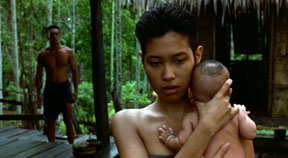
The film is set in a rural area of northern Thailand, where the title character Boonmee (Thanapat Saisaymar) has a successful farm. We see him out among his workers, one of whom shows him the pest problem they have in their tamarind grove. Boonmee is concerned about his farm and his workers, since he is in end-stage renal failure and has no heirs to whom to leave the farm. His sister-in-law Jen (Jengira Pongpas) has come up from Bangkok with her son Tong (Sakda Kaewbuadee) to look after Boonmee. She worries about the immigrants he has employed to work on his farm, particularly a young man from Laos who handles Boonmee’s dialysis treatments: “Aren’t you afraid they will kill you and steal from you?” It’s obvious that Jen will not accept his offer to give her the farm, even with Boonmee’s promise that he will return as a ghost to help her out.

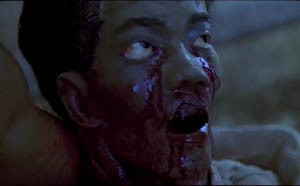
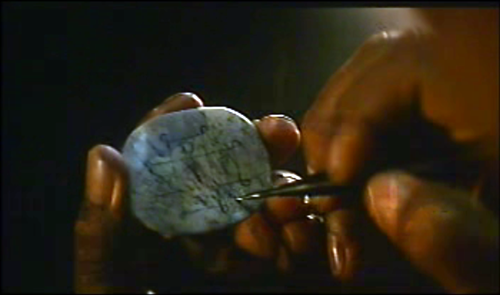
This promise isn’t as empty as a Western viewer might think. During a dinner the three are sharing, the ghost of Boonmee’s wife Huay (Natthakarn Aphaiwonk) appears. She says hello to her sister and nephew and later tends to Boonmee’s care after his Laotian helper returns to Laos to marry. Also joining them at the family table is Boonmee and Huay’s long-lost son Boonsong (Geerasak Kulhong), who has become a monkey ghost. His dark form and glowing red eyes don’t seem to frighten anyone, and he tells his father he watched the search parties Boonmee sent out to look for him but didn’t dare return. He had set out into the woods to search for a monkey ghost he had photographed and ended up mating with it. Weerasethakul films the flashback—the darkroom where the photo was developed, Boonsong’s search in the forest, the search party—one of the films within the film.

The main film will be interrupted several times to tell different stories that may or may not relate to Boonmee’s past lives, including an absolutely mesmerizing story of a homely princess who mates with a catfish that quite reminded me of a mythic story of agrarian communities I heard from Joseph Campbell about . It seems clear that Weerasethakul based this film not only on a book of past-life stories a monk collected from people he encountered, but also on universal mythic traditions. He also seems to chart the evolution of the human race, as Boonmee, followed by Jen and Tong, is led into a deep cave like a salmon to its birthplace and, there, expires. His funeral comprises the last leg of the film, which will see a worldly monk from Bangkok become spooked in the rural monastery and seek refuge in Jen’s hotel room, and one final surprise from Weerasethakul. Not only does the monk use the hotel shower in an extended sequence that vaguely echoes the homoeroticism of Weerasethakul’s previous films, but he also goes out to dinner with Jen, only to look back before they leave the room to see them still sitting on the edge of the bed watching television. Weerasethakul’s comment about cinema’s ability to have two “lives” occurring simultaneously (the real life of the actor, including his ability to watch himself on the screen while sitting in a theatre, and his character’s life) is a staple of experimental film, but it also refers to his examination of reincarnation.

Uncle Boonmee is the last part of Weerasethakul’s “jungle” trilogy (I’d call it a reincarnation or time trilogy myself) that includes Tropical Malady and Syndromes and a Century. With each film, the director has grown more confident in mixing the worlds he has wanted to explore. The first film was clearly demarcated into two halves: one, a standard drama of a budding homosexual relationship and a fable about the encounter between a soldier and a powerful shaman who transformed himself into a tiger that suggests the consuming power of love. Syndromes and a Century looked at the continuity of human behavior and interactions and, thus, history’s tendency to repeat itself, as Weerasethakul explored his parents’ history in its first half and then updated it to modern times with the dialogue nearly the same in each half. With Uncle Boonmee, Weerasethakul has gone for the big score, showing how all times coexist—and certainly personal memory mixed with national history and the collective unconscious shows this to be true. The ambition of this film is enormous, and that Weerasethakul pulls it off with grace, humor, and beauty shows his is a talent that has finally matured. I sincerely hope audiences will dig deep and allow his connection with our symbolic and mythic dimensions to reach them.
Uncle Boonmee Who Can Recall His Past Lives screens Sunday, October 10, 3 p.m., and Friday, October 15, 6:30 p.m. (rush tickets only). All screenings take place at the AMC River East 21 Theatres, 322 E. Illinois St.
Previous CIFF coverage
The Last Report on Anna: A dreamy, romantic film centering on Anna Kéthly, real-life Hungarian minister in exile, and a spy’s attempt to silence her by seducing her into returning to their communist-controlled country. (Hungary)